In Chapter 15, Epstein talks about "The Normal Conditions" and goes and relates to the example he gives of spot and dick. Epstein goes on and explain why the normal conditions are important to cause an argument or example to be valid or strong. According to Epstein, Normal Conditions are "for casual claim, the normal conditions are the obvious and plausible unstated claims that are needed to establish that the relationship between purported cause and purported effect is valid or strong" (303). Epstein uses the example about Dick and Spot to show how the concept of normal conditions is use and the example is:
"Dick was sleeping soundly up to the time that Spot barked.
Spot barked at 3 a.m.
Dick doesn't normally wake up at 3 a.m.
Spot was close to where Dick was sleeping.
There was no other loud noise at the time...." (303).
Epstein explains that its important to leave or exclude the obvious and normally we assume that things are the "normally" just like that. For instance in the example above, Dick normally doesn't wake up wake up at 3 a.m. and we need to assume that things are normally like this that Dick never tends to wake up at 3 a.m. but this time he did. This concept was just interesting to me and made sense when Eptein conclude the normal conditions in his example of Dick and Spot.
Saturday, April 30, 2011

Friday, April 29, 2011
Since both of these websites are from the same SJSU source I would have to say that both were helpful. However the main Mission Critical homepage offered more information and I liked how the concepts were broken down by categories, some of which we have read in class. Although we had already covered concepts such as: vagueness, ambiguity, premise, conclusion, validity and burden of proof, it was interesting to read the alternate definitions and use of the concepts.
In addition, it appeared there were concepts not covered like: universal statements, but this was another term for the concept of general claims using “all” and “none”. There were some concepts that were unfamiliar such as: universal and non- universal syllogisms and a more familiar, but so far undiscussed concept of hasty generalizations – a fallacy that draws a conclusion (or assumption) about a population based on a sample that is not large enough.
Example: I read where there have been no reported cases of HIV infection in Liberty Lake. The people of Liberty Lake must be free of the HIV virus. These examples as well as the exercises are always helpful, because they can clarify the concepts, give you detailed feedback for incorrect answers and give you a way to see how the concept is correctly used.
Wednesday, April 27, 2011
Who's fault?
I felt the Cause and Effect to be a confusing website to understand in one gulp due to all the information being splayed throughout the web page. If they had condensed it by narrowing down and outlining the important information of casual arguments, it may have been clearer for me to understand and grasp the information for the first time. However, there were some interesting examples on the website that helped me to understand the concept of casual arguments.
The most confused part to me was the example of the bicyclist and the illegal truck. First, it explains the claims given by the bicyclist and illegal truck to defend their cases "seems to fit the pattern of an inductive argument, because none of them seems based on observation or experience. But, in fact, they do fit that pattern. “And then the website explains to that inductive reasoning is based on observed instances; however this argument didn’t require such observations because of the similar arguments that the lawyers came up with. That part got me confused in seeing when a causal argument can make do without using observational instances to defend a stance.
The most confused part to me was the example of the bicyclist and the illegal truck. First, it explains the claims given by the bicyclist and illegal truck to defend their cases "seems to fit the pattern of an inductive argument, because none of them seems based on observation or experience. But, in fact, they do fit that pattern. “And then the website explains to that inductive reasoning is based on observed instances; however this argument didn’t require such observations because of the similar arguments that the lawyers came up with. That part got me confused in seeing when a causal argument can make do without using observational instances to defend a stance.
Saturday, April 23, 2011
analogies in the law
In Epsteins book, Chapter 12 discusses analogies in the law, I found that concept of the chapter interesting. Epstein mentions how most analogies that are made are not detailed and understandable to be good arguments, but when it comes to the law it’s completely different.
Analogies in law are presented as detailed, explicit, and clear which are carefully analyzed arguments that point out important similarities to which a general principle is stated. Laws that are unclear or are vague have to have their similarities and difference pointed so that it is easy to reason with it.
These general principles that are enunciated have to be respected by other judges. It doesn’t state that it is law for a judge to follow/respect other judges’ decisions. The books talks about how judges use this general principle to conclude cases that are thrown at them. They take into account all the differences of each case and make a new decision. They need to decide whether or not to respect or overthrow the previous judges decision.
Friday, April 22, 2011
When studying the information in the link provided, I had the most trouble understanding reasoning by criteria. It took me longer to comprehend the concept mainly because of the terminology used.
After researching it in other sources, it became easier to understand. To use this kind of reasoning, criteria by which you can associate a valid argument with a premise must be established. After researching this topic, it was easier to grasp the concept by having more examples to look at. Also, I learned that it using this reasoning in an argument may make an argument seem stronger.
An example I came up with is when a basketball player is struggling with his jump shot. A coach would use reasoning by criteria by telling his player, "You're just not hitting those jumpers today. You should try to take some easier shots and get yourself in a rhythm and build your confidence." Rather than crucially criticizing that player, he used his reasoning to constructively criticize.
Wednesday, April 20, 2011
1). Reasoning by Analogy - My brother doesn't get good grades, yet my parents bought him a car. I have great grades so I should get a car; maybe even a better one.
2). Sign Reasoning - It's been a month since he sprained his ankle during a game. He hasn't played since so it must still be bothering him.
3). Causal Reasoning - If I don't really have much sleep, I will be very cranky.
4). Reasoning by Criteria - My shoes make my feet hurt. I should probably buy new ones.
5). Reasoning by Example - My friend drank 17 shots within one hour. Consequently, he was having seizure and his body temperature went lower from alcohol poisoning. If I were you, I wouldn't drink that much in that short time span.
6). Inductive - I didn't study at all for the last exam and got a bad grade. This time, I'll put time in to study so I can get a better grade.
7). Deductive - If he studies, he will pass the test. He studied thoroughly, so he will the test.
Saturday, April 16, 2011
don't get her anything!
An appeal to spite is a way for an individual to get "even" with another person to justify their reasoning for doing such actions. These actions are from bitterness and hatred towards the other person.
For example:
Megan: Jamie's birthday party is coming soon. Have you gotten anything for her?
Misao: I just ordered her gift on Ebay. I got her a Polaroid camera and films that she always wanted.
Tammy whispers to Misao: Dude, remember at your 20th birthday party, Jamie didn't even get you anything.. Why are you even bothering to get her one?
Tammy argues that Misao shouldn't buy a gift for Jamie's birthday because Jamie did not give a present to Misao when it was her birthday.
A stronger premise to this argument would be, "You should not give others gifts if they did not give one to you." Even so, I don't find this to a rational reason to justify not giving a gift. It's a bit selfish to me in my opinion. Just because Jamie didn't give Misao a gift on her birthday, it does not make it legitimately right for Misao to turn back and do the same thing to Jamie, instead it would be due to intentions of spite.
Friday, April 15, 2011
Nice Teeth, eh :D
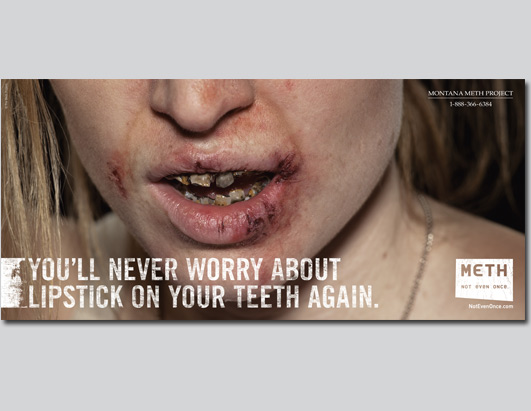
This is an anti advertising for meth. It is obviously seen as an appeal of fear from the woman with uneven, stained teeth and scratches and scabs on her lips and face. Who would want that?
The appeal to fear is that if a person does not want to end up looking like the woman above, they should most definitely not start using meth. The sarcasm of the advertisement: "You'll never worry about lipstick on your teeth again," is very intriguing. It made me think, "That is not the kind of lipstick I would like on my mouth." To me based off this advertisement, meth is not worth it and has negative effects orally.
To sum up this advertisement as an argument, the premise would be that if a person uses meth, then their mouth would look like the picture. This is considered as a valid argument. Use meth and you will get problems in your mouth. The premise and conclusion cannot be true and false at the same time.
Tuesday, April 12, 2011
appeal to emotion
An appeal in emotion in an argument is a premise that suggests that one must believe or do something because he or she feels that way. There are many different types of an appeal to emotion, such as an appeal to fear, an appeal to vanity, an appeal to spite, and an appeal to pity.
Whenever I see an bro-sure or an advertisement of an organization, which mainly focuses about people with some sort of cancer, kids with cancer, Japan crisis, or some animal abuse. I normally see pictures of sickly people, needy children, the destroyed area of Japan, or abused animals on the ad. Those pictures are used to make people feel sympathy towards them and cause them to feel like they must do something to help.
This was an example of appeal to pity which is the one that strikes me the most. It's the appeal that hits me most mainly because I'm the type of person that can sometimes care too much about someone or something. I realize that there are those who are less fortunate then most, so I help as much as I can. Seeing sickly people or hurt animals that are in need bring out this side of me that forces me to do something.
Subscribe to:
Posts (Atom)
